
02.12.26
Systemic Solutions: Addressing the Root Causes of Workforce Challenges
By Jane Vangsness Frisch, Vice President of Workforce, FMWF Chamber
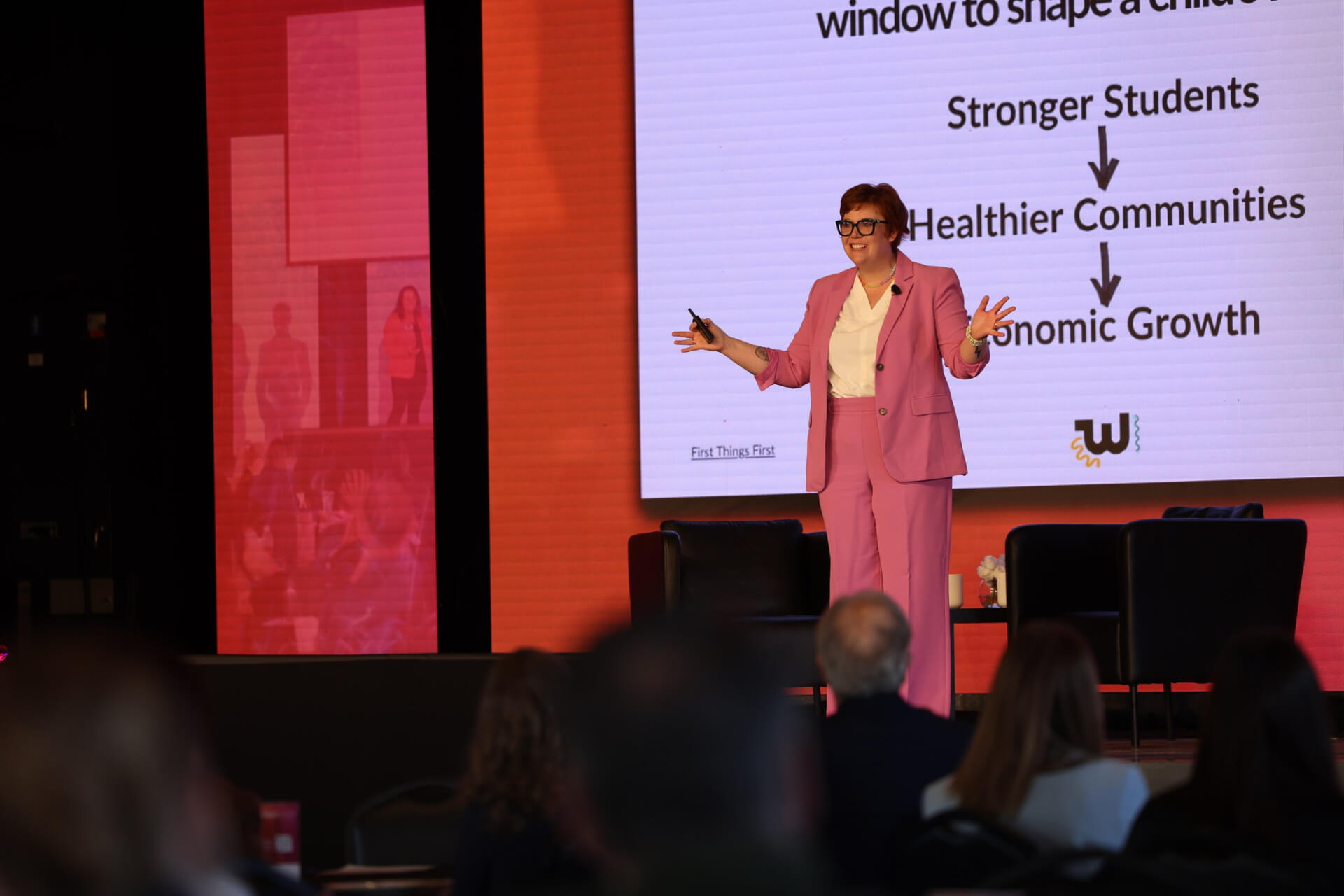
Callie Adamson Bakken, founder of Wiggle Work, addressed the significant economic impact of the child care shortage.
Workforce challenges go beyond hiring. Learn how housing, immigration and child care shape the region’s talent pipeline.
The workforce shortage in the Fargo-Moorhead-West Fargo region is not solely a recruitment problem; it is a community infrastructure challenge. Following the forward-looking keynote by futurist Rebecca Ryan, The Chamber’s 2026 Workforce Forum shifted focus to the immediate, data-driven realities facing employers today.
To move from vision to action, The Chamber convened regional experts to address three critical factors impacting the labor market: housing stability, immigration and child care. These presentations highlighted that workforce issues cannot be solved in isolation. They require a cohesive approach where business leaders, nonprofits and policymakers align to remove barriers for the region’s talent.
Stabilizing the foundation: housing access
Taylor Syvertson, director of community impact at United Way of Cass-Clay, presented a stark reality regarding housing instability.
While homelessness is often viewed as a visible crisis on street corners, data shows that 90% of the local unhoused population is unseen. Currently, more than 1,050 people in the community are experiencing homelessness, and the majority are working individuals and families
Syvertson noted that many of these individuals are "zipping up their child's coat in the morning, sending them off to school, having slept in their car overnight" before heading to work.
The presentation emphasized that housing is a fundamental workforce issue. When employees are cost-burdened — spending more than 30% of their income on housing — one crisis, such as a flat tire or medical bill, can lead to eviction and job loss. Through the United to End Homelessness initiative, The Chamber and United Way are partnering to build a support system that prevents these crises, ensuring economic vitality for the region.
Fueling growth through New American talent
With the region unable to meet employment needs through birth rates alone, attracting newcomers is essential. Dan Hannaher, field office director for Global Refuge, outlined how refugee resettlement functions as a "three-legged stool" comprised of humanitarian aid, national security and economic development.
Since 2021, Global Refuge has welcomed more than 700 individuals to the area, many of whom possess high-level skills, including doctors, professors and business owners seeking new pathways. Through the Employer Engagement Program (EEP), Global Refuge partners with companies to create internal career paths for New Americans, moving them from entry-level jobs to management positions.
The message to employers was clear: Hiring New Americans is not charity; it is a strategic business decision that fosters loyalty and fills critical gaps in the labor market. To learn more about how to engage with EPP, please connect directly with Global Refuge or reach
Solving the child care deficit
Callie Adamson Bakken, founder of Wiggle Work, addressed the significant economic impact of the child care shortage. North Dakota currently faces a 75% to 80% shortage of available child care spots, while Minnesota is short roughly 85,000 seats.
Adamson Bakken further described this deficit as a "$122 billion workforce issue" that costs North Dakota businesses $354 million annually, she challenged the misconception that child care is merely a personal expense, presenting data showing that workplace child care programs can increase retention by 50% and reduce absences by 13%.
To address this, Adamson Bakken encouraged employers to utilize the Employer-Provided Childcare Credit (45F). This federal tax incentive is designed to offset costs for businesses that acquire, construct, rehabilitate or expand a child care facility. Beyond construction, the credit also supports operating expenses, including training and increased compensation for child care staff, as well as costs associated with contracting resources and referral services for employees. By leveraging these incentives and considering workplace child care models, employers can help stabilize their workforce and support the next generation.
Leading the charge
The Chamber is actively spearheading efforts to solve these systemic issues by partnering with organizations like the NSF AgTech Engine, Minnesota DEED and the FMHRA. By connecting employers with resources like the Employer Engagement Program and advocating for housing and child care solutions, The Chamber is ensuring that the region does not just discuss these problems but solves them.
Workforce challenges will persist, but so will the region’s commitment to innovation. As Chamber President and CEO Shannon Full noted, the community’s ability to come together is what makes this region competitive. "Systems don't shift because of one program, one organization, or even one leader," Full said. "The conversations happening here and the people behind these efforts are what helps move our region from vision to action."
Take the next step. The conversation doesn’t end here. Follow the FMWF Chamber on social media, subscribe to our newsletter and watch for workforce events to stay engaged on these issues in the months ahead.
If your organization is facing workforce challenges tied to housing stability, talent access, or child care, the Chamber’s Industry Sector Partnerships offer a practical way to engage. These employer-driven convenings are designed to respect leaders’ time while delivering real value—bringing businesses together with educators, workforce organizations, and community partners to identify current challenges, validate solutions, and align investments for the greatest return. Through biannual Industry Sector Partnership meetings across healthcare, advanced manufacturing, cybersecurity and IT, and agriculture and food, employers gain influence in shaping regional strategies, reduce duplication of effort, and help build talent pipelines that support both individual organizations and the long-term strength of the region’s workforce system.
The Chamber’s workforce team also serves as a resource for employers navigating these issues and can help connect organizations to partnerships, programs, and next steps aligned with their needs. To learn more or get involved, contact Jane Vangsness Frisch, jvfrisch@fmwfchamber.com
SHARE
More Stories
Upcoming Events
Subscribe to email newsletters