
02.02.26
The Time Is Now: Why Business Leaders Must Step Forward Into Public Service
By Charlie Adams, Center for Civic Engagement Lead, FMWF Chamber
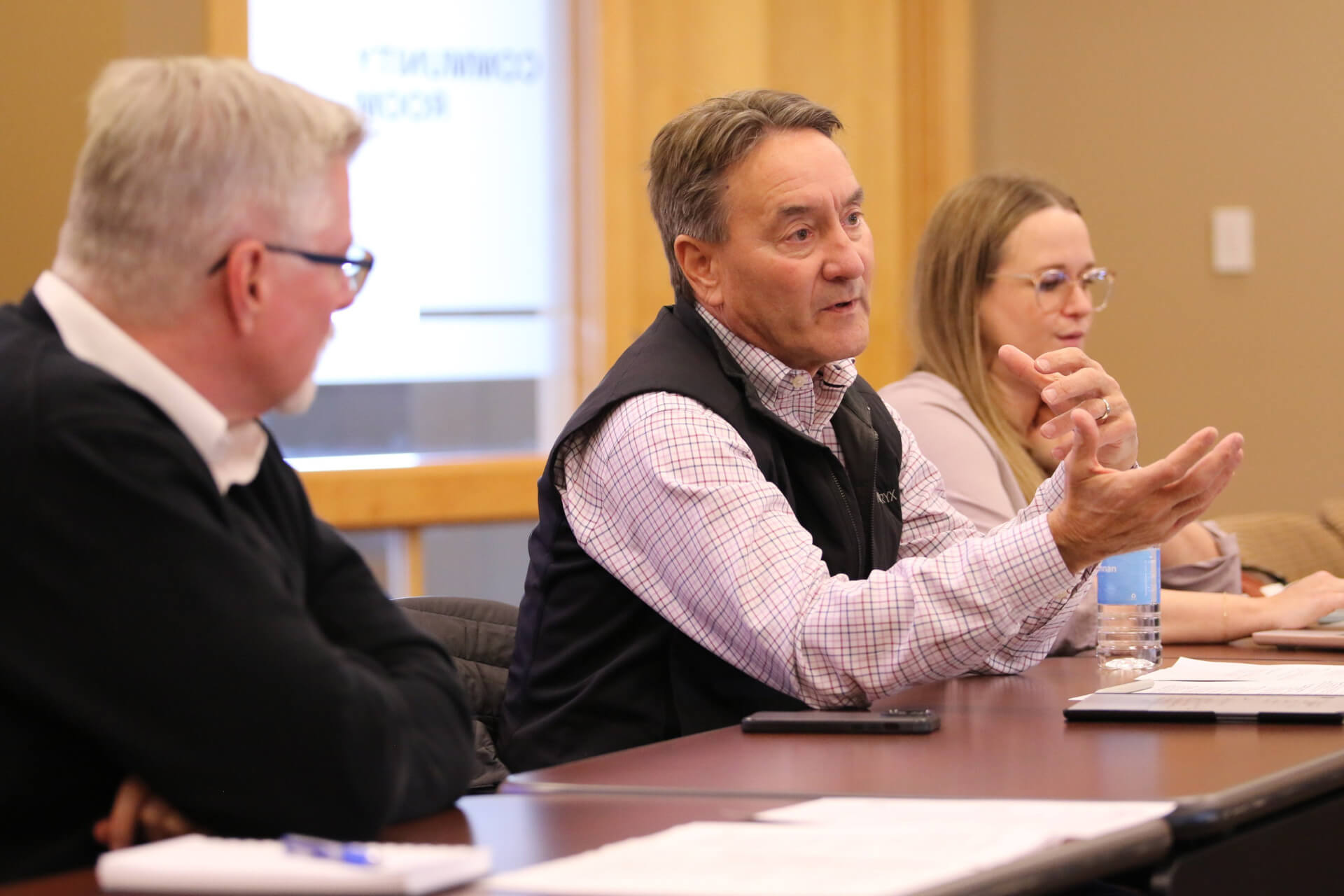
Former Congressman Rick Berg (middle) engages in conversation with business leaders during a regional meeting focused on civic leadership and public service.
Public service needs business leadership. Learn why early engagement matters and how leaders can prepare to step forward.
There is a familiar pattern in business.
You see a problem coming long before it becomes a crisis. You talk about it around the conference table. You make note of it during strategic planning sessions. You hope someone else will step up and address it. And then one day, you realize the problem that you hoped would fix itself actually grew.
Civic leadership is at one of those moments.
Across Minnesota and North Dakota, the 2026 election cycle is no longer a distant concept. Party organizations are already preparing. Caucuses are scheduled. Endorsement processes are taking shape. Candidate recruitment conversations are happening, with or without the participation of the business community.
And that’s the point worth considering.
Decisions Are Being Made Before Election Day
Decisions about who will lead our cities, school boards, counties and statehouses are being made right now. Not on Election Day, but in the months and years leading up to it. The question isn’t whether the process will move forward. It will. But, the real question lies in who chooses to be part of it.
Running a business teaches lessons that cannot be learned from a textbook or talking points.
You learn how to manage budgets under pressure. You learn how to make decisions with incomplete information and turn to the resources and knowledge you do have. You learn how to balance competing priorities without the luxury of perfection. You learn that every decision has downstream consequences for employees, customers, families and communities.
Public service needs those skills.
Local and state governments are responsible for complex systems that affect everything from workforce development and infrastructure to education, housing and public safety. These systems don’t run on ideology alone. They require judgment, accountability and an understanding of how decisions play out in the real world.
That’s where business-minded leaders bring unique value. Not because they have all the answers, but because they are trained to ask better questions and take responsibility for the outcomes.
Many capable professionals quietly opt out of public service long before they ever consider running.
They assume they’re not “political enough.” They worry about time commitments. They wonder how it would affect their families or their careers. They tell themselves, “Maybe someday, but not now.”
Meanwhile, the pipeline continues to narrow.
Fewer people are stepping forward, and fewer candidates run unopposed. And too often, communities are left choosing between limited options rather than strong, thoughtful leadership.
This is not a critique of the system. It’s a reality check.
In both Minnesota and North Dakota, political parties are beginning the formal processes that lead to endorsements for elected offices. Precinct caucuses, district conventions and delegate selections are real, structured moments where leadership paths begin.
For anyone even considering public service, the window to prepare is now.
Preparation does not mean committing to a campaign. It means learning how the system works, understanding expectations and asking honest questions about readiness, timing and impact.
Stepping into public service is not about party labels. It’s about stewardship.
Strong communities depend on people who are willing to show up, listen, collaborate and solve problems. That work transcends ideology. It requires mutual respect, a long-term view and a willingness to engage constructively even when disagreements exist.
The Center for Civic Engagement exists for this reason. It was created to help create space for learning, preparation and connection without pressure or partisanship. To lower the barrier for capable people who care deeply about their communities but may not know where to start.
If not you, then who?
If not now, then when?
Every election cycle moves forward whether strong candidates step up or not. The difference is whether communities benefit from leaders who understand how decisions affect jobs, families and long-term growth, or whether those voices remain on the sidelines.
The time is not someday. The time is not after the next cycle. The time is now.
And stepping forward doesn’t always begin with a campaign. Sometimes it starts with a conversation, a mentor or simply the willingness to learn what public service really entails.
Strong civic leadership doesn’t appear overnight. It’s cultivated thoughtfully, intentionally and together.
That work has already begun. And we hope you join.
SHARE
More Stories
Upcoming Events
Subscribe to email newsletters