
03.18.25
Minnesota Legislative Session Update: Gridlock, Budget Pressure and Key Tax Policy Debates
By Cale Dunwoody, Vice President of Public Policy, FMWF Chamber
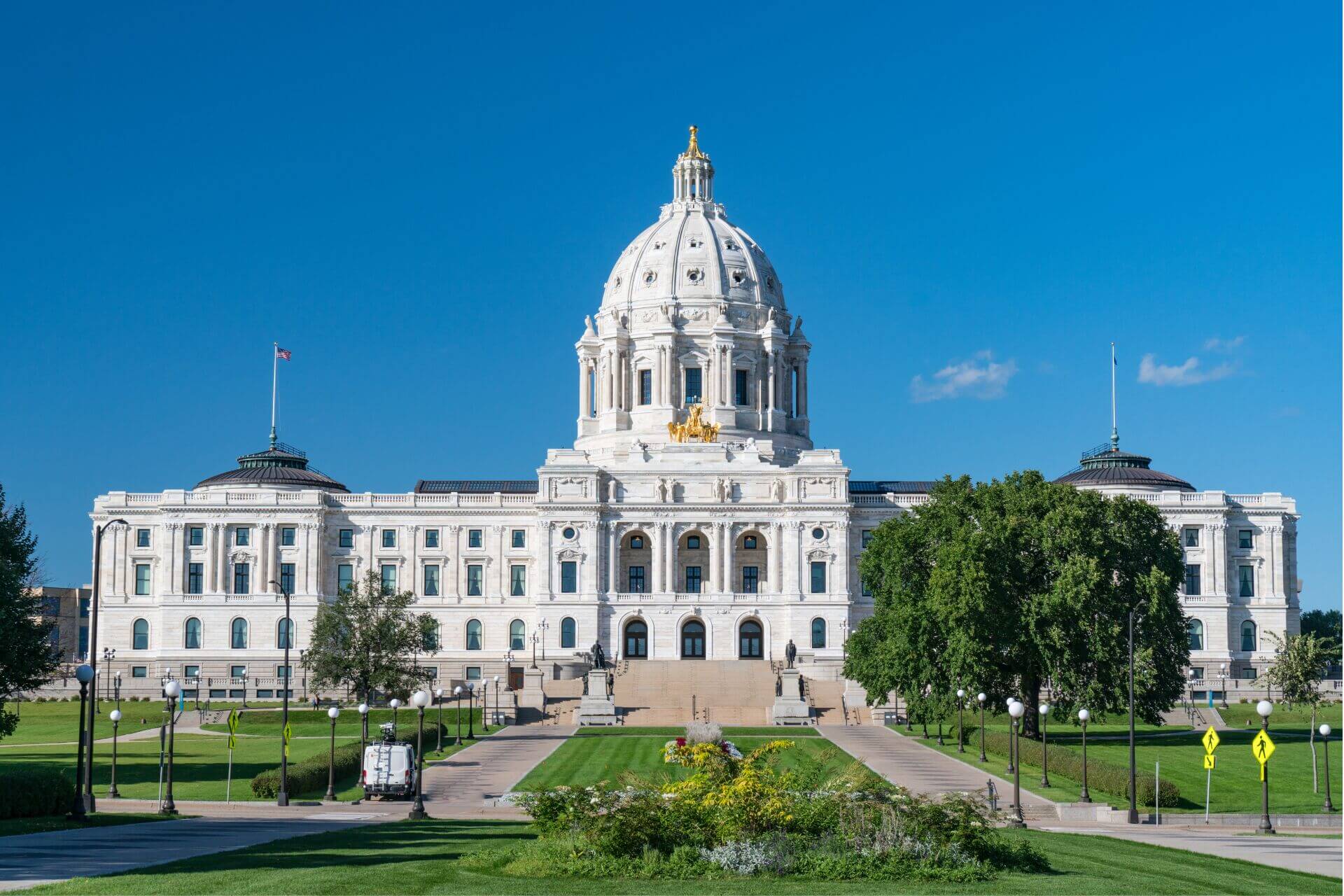
Minnesota State Capitol Building in St. Paul, Minnesota. (credit: paulbrady)
Image caption here, size 16 font. Photo courtesy of NAME. Or photo by NAME (if its not from us)
Minnesota’s legislative session is underway, and the decisions being made right now will directly impact how businesses operate, invest and grow across the state.
This update breaks down what’s happening at the Capitol, what it means for your organization and where your voice is needed.
With a divided legislature and key deadlines approaching, business input will play a critical role in whether important policies, including tax conformity measures, move forward this session.
After one month in session, a clear dynamic has emerged: progress will depend on bipartisan agreement.
The Minnesota House is evenly split 67-67 between Republicans and Democrats, while the Senate holds a narrow one-seat DFL majority. As a result, any legislation that advances this session will require support from both parties.
With committee deadlines approaching March 27 and adjournment scheduled for May 18, lawmakers face a compressed timeline to move priority policy forward.
Budget forecast sets the stage for legislative decisions
At the end of February, Minnesota Management and Budget (MMB) released its annual February Budget and Economic Forecast. According to MMB, “spending growth outpaces revenue growth through projections for FY 2029,” leaving a projected general fund balance of $377 million for the FY 2028-29 biennium, while a significant structural imbalance remains.
The forecast shows the state ending the current biennium (FY 2026-27) with a projected surplus of $3.734 billion. However, looking ahead to the following biennium (FY 2028-29), the state faces a projected structural deficit of roughly $3.357 billion when accounting for inflation.
In practical terms, this means the legislature cannot pass spending bills that increase expenditures by more than $377 million without either raising revenue or cutting spending elsewhere in the budget.
These fiscal realities will shape nearly every policy discussion during the remainder of the session.
Major policy debates dominating the Capitol
While budget discussions are ongoing, two major issues have dominated conversations at the Capitol: fraud prevention and immigration policy.
These large, complex topics have consumed much of the legislature’s attention, limiting the time and political bandwidth available for other policy priorities.
A recent example of this dynamic involves House File 3127, legislation addressing the state’s Pass-Through Entity Tax (PTET).
The bill is widely considered a pro-small business measure and does not have a direct fiscal impact on the state budget. However, it failed to receive bipartisan support in the House Taxes Committee last week, preventing it from advancing to the House floor.
Meanwhile, the Senate companion bill passed unanimously through the Senate Taxes Committee just one week earlier.
Why tax conformity is important for Minnesota businesses
The PTET proposal is part of a broader effort to align Minnesota’s tax code with recent federal tax changes.
Specifically, the legislation would help Minnesota conform to federal tax provisions included in H.R. 1, commonly referred to as the One Big Beautiful Bill Act.
Without these updates, Minnesota’s tax code will not automatically align with federal changes, creating additional complexity for businesses and potentially making the state’s tax environment less competitive.
For many businesses, tax conformity helps streamline compliance and ensures that state tax policy keeps pace with federal updates that affect how companies operate and invest.
Action alert: Business community engagement needed
The Chamber encourages members of the business community to contact local legislators and key members of the House Taxes Committee to urge advancement of tax conformity measures.
These policies play a critical role in maintaining a competitive business environment in Minnesota.
Priority legislation includes:
- Pass-Through Entity Tax (House File 3127)
- Research and Development Expensing (House File 3816)
- Section 179 Expensing (House File 3814)
- Business Interest Expensing (House File 3815)
- Bonus Depreciation (House File 3817)
Sharing how these policies impact your organization can help legislators better understand the real-world implications for Minnesota employers.
Clay County House Members
Rep. Heather Keeler
rep.heather.keeler@house.mn.gov
Rep. Jim Joy
rep.jim.joy@house.mn.gov
Rep. Steve Gander
rep.steve.gander@house.mn.gov
House Taxes Committee Leadership
Co-Chair Greg Davids
rep.greg.davids@house.mn.gov
Co-Chair Aisha Gomez
rep.aisha.gomez@house.mn.gov
Co-Vice Chair Jim Joy
rep.jim.joy@house.mn.gov
Co-Vice Chair Matt Norris
rep.matt.norris@house.mn.gov
SHARE
More Stories
Upcoming Events
Subscribe to email newsletters