
02.24.26
2026 Midwest Economic Outlook: Minneapolis Fed President Neel Kashkari on Interest Rates, AI and the Labor Market
By Jane Vangsness Frisch, Vice President of Workforce, FMWF Chamber
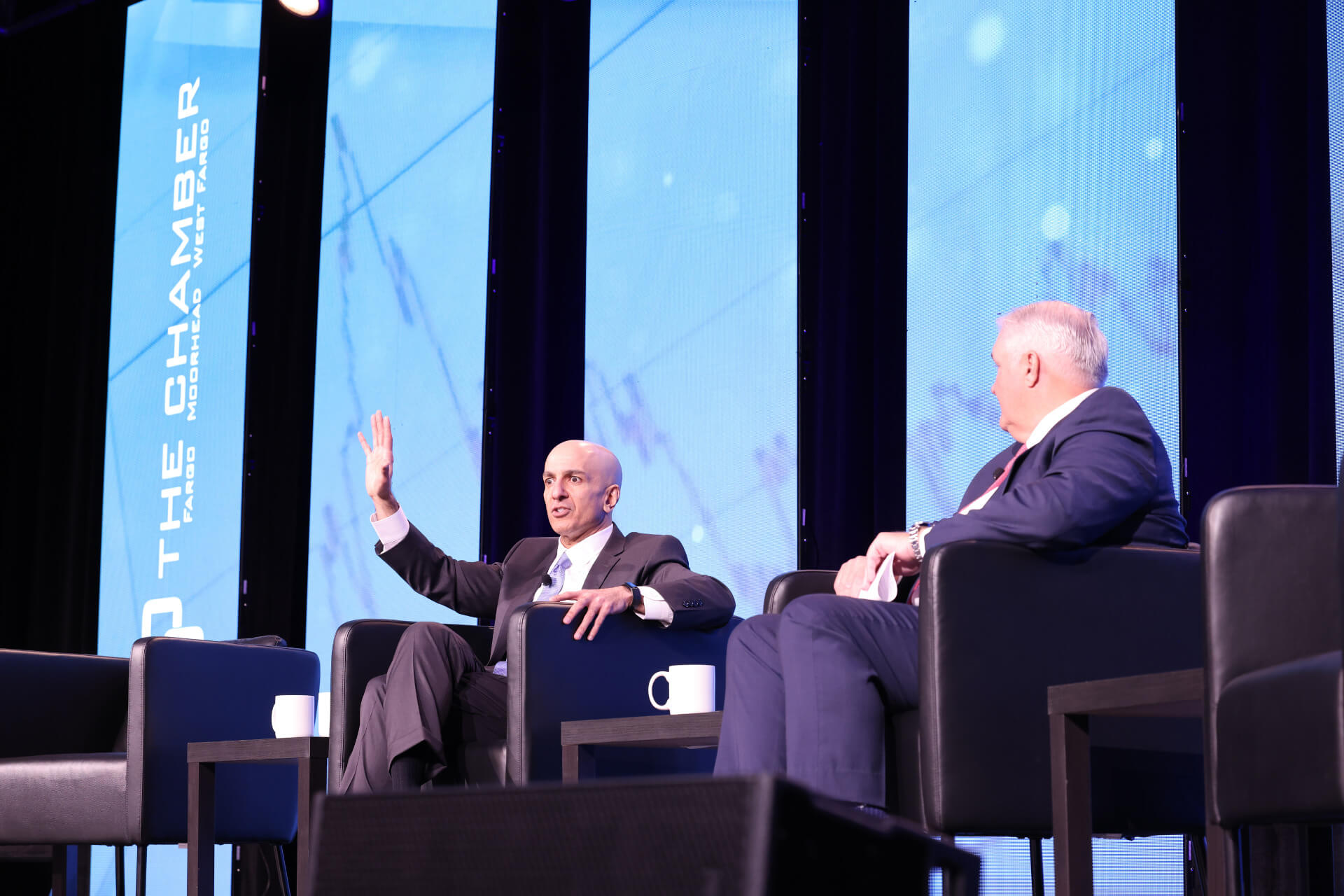
Neel Kashkari, president and CEO of the Federal Reserve Bank of Minneapolis, speaks during a fireside chat at the FMWF Chamber’s 2026 Midwest Economic Outlook Summit.
Neel Kashkari, president and CEO of the Federal Reserve Bank of Minneapolis, shares the 2026 Midwest economic outlook.
Business leaders and community stakeholders gathered for the FMWF Chamber’s annual Midwest Economic Outlook Summit to examine the economic forces shaping 2026.
A highlight of the event was a fireside chat featuring Neel Kashkari, president and CEO of the Federal Reserve Bank of Minneapolis, and Jim Ryan, chairman and CEO of Old National Bank. The discussion focused on how national macroeconomic trends are affecting the Upper Midwest.
Here are key takeaways from the conversation.
Why did the Federal Reserve cut interest rates?
The Federal Reserve raised interest rates aggressively in response to post-pandemic inflation, which peaked between 7% and 9% amid supply chain disruptions and elevated demand.
With inflation cooling to roughly 2.5% to 3%, the Fed began cutting rates. Kashkari noted that the U.S. economy remained resilient even when borrowing costs were at their highest — a development he described as surprising given historical expectations.
How is the Midwest labor market performing?
National unemployment has edged up slightly to about 4.3%, but the Upper Midwest presents a different picture, with unemployment in the Fargo-Moorhead MSA hovering at about 2.7%
During a roundtable with North Dakota business leaders prior to the summit, employers reported being fully staffed. Kashkari noted it was the first time in a decade he had heard that assessment in North Dakota, a state that has historically faced structural workforce shortages.
In a recent interview, Neel Kashkari, President and CEO of the Federal Reserve Bank of Minneapolis, observed, “What I heard was more of the traditional service workers. They’re more fully staffed in some of those sectors that are less skill specific. And that indicates that, to me, the overall labor market is softer than it was a couple years ago.”
What is causing the structural housing shortage?
When addressing the high cost of housing, Kashkari pointed out that the U.S. faces a structural shortage of homes. He attributed the lack of affordability to more than just interest rates. The core issues driving up housing costs are local zoning restrictions, the cost of materials and a shortage of construction labor.
How will AI and cryptocurrency impact the economy?
Neel expressed strong optimism for AI, noting that almost every large business he speaks with is already using the technology and finding real benefits. He predicted AI could be a significant boost for economic productivity over the next five to 10 years.
To emphasize AI's rapid integration, Neel drew a sharp contrast with cryptocurrency. He asked the audience to raise their hands if they had used an AI tool in the past week, noting many hands quickly went up. He then asked who had recently bought or sold something with Bitcoin.
"Crypto has been around for more than a decade, and it's utterly useless," Neel said. "AI has not been around very long, and people are using it every day".
The conversation shifted to payment innovations like stablecoins. Neel advised leaders to ask basic, practical questions and not settle for "word salad nonsense answers" when pitched on these technologies. For example, he questioned what a stablecoin can do that apps like Venmo or PayPal cannot already do instantly. Even for international payments — such as sending money to his father-in-law in the Philippines — Neel pointed out that his father-in-law would still have the cost and friction of converting the digital coin into local currency just to buy groceries. He noted that unless the entire world abandons their own monetary policies to use the same currency platform, those frictions will remain.
Watch the full conversation in Part I on YouTube.
Why does Federal Reserve independence matter?
Kashkari strongly defended the independence of the central bank amid political noise. He emphasized that economies worldwide are better off when monetary policy is based strictly on data and analysis, rather than short-term political gains. He also clarified that the Fed does not control fiscal policy, such as government spending or the national debt, which is largely driven by an aging demographic and must be addressed by elected officials.
What is the best advice for business leaders navigating uncertainty?
When Ryan asked for his best advice for business and community leaders, Kashkari offered a simple guiding principle: "Focus on what you can control." He encouraged leaders to remain disciplined, tune out the noise and remember that the U.S. economy still has a tremendous amount going for it compared to the rest of the world.
Watch the full 2026 Midwest Economic Outlook conversation:
Part I | Part II
SHARE
More Stories
Upcoming Events
Subscribe to email newsletters